
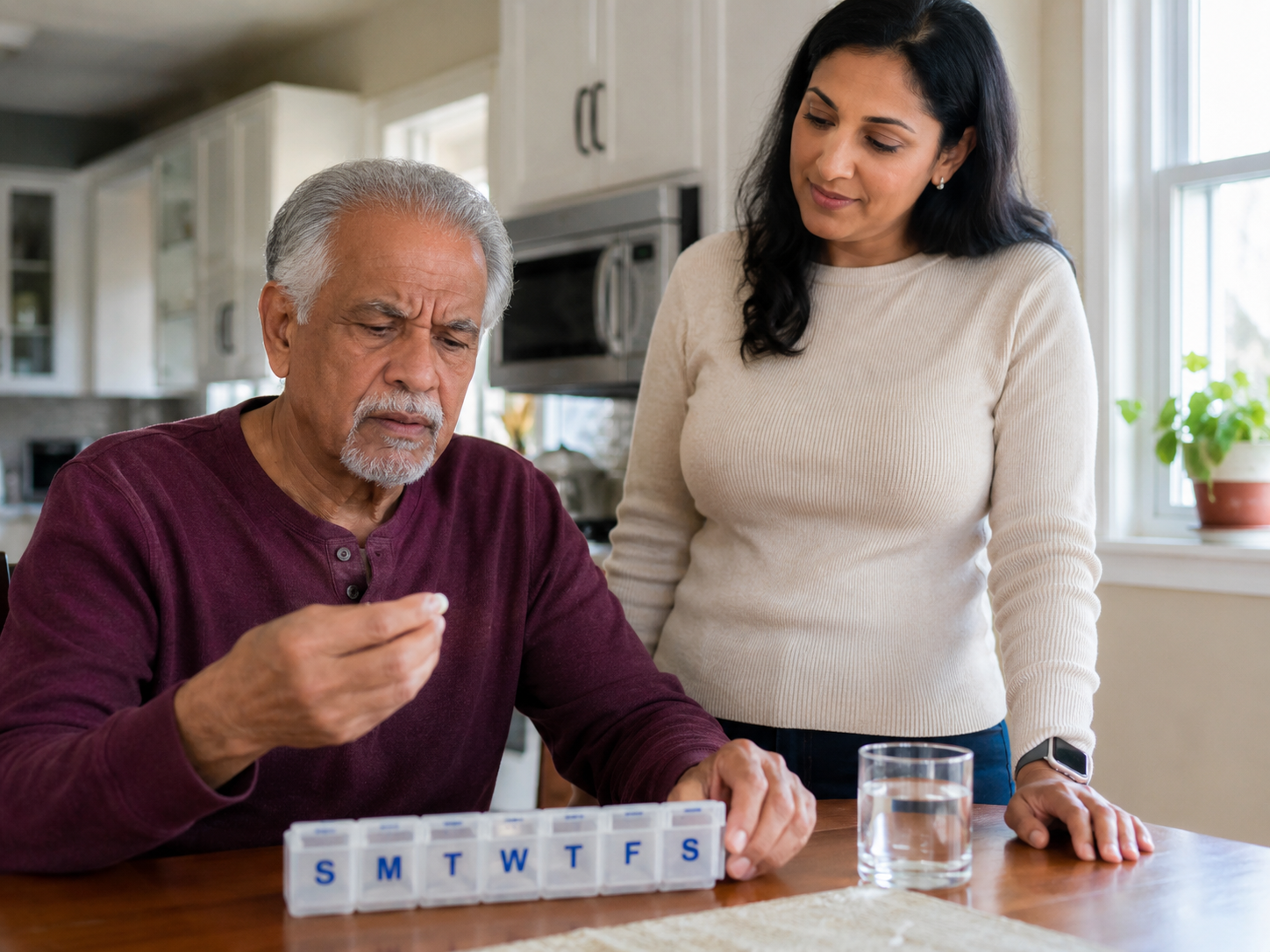
Robert’s daughter thought she had it covered.
She’d set up a weekly pill organizer, written out the schedule, and gone through it carefully with her father before leaving after a Sunday visit. By Thursday, she called to check in. He’d taken Tuesday’s pills twice — he couldn’t remember whether he’d taken them, so he took them again, just in case.
Nothing catastrophic happened that time. However, it was a warning sign that a well-intentioned system wasn’t working — and that the stakes of getting it wrong were real.
Medication errors are one of the most common, and most underappreciated, safety risks for seniors aging at home. Yet most families assume the situation is under control because a system of some kind is in place. Often, it isn’t — not reliably.
The Institute for Safe Medication Practices Canada is the country’s leading organization focused on medication error prevention. Their resources for patients and caregivers offer practical guidance that families navigating complex medication regimens will find genuinely useful.

Why Medication Management Is So Complex for Seniors
Managing a handful of simple medications is straightforward. Managing the reality of most seniors’ medication regimens — which is often far more complex — is something else entirely.
The Polypharmacy Problem
Polypharmacy — taking five or more medications simultaneously — affects a significant proportion of Canadian seniors. Many take ten or more. Each medication has its own schedule, dosage, and set of potential interactions with the others. Furthermore, as new conditions emerge and new prescriptions are added, the complexity grows — often without anyone stepping back to review the full picture.
Drug interactions are common and consequential. A new medication added for one condition can change how an existing medication works, increase side effects, or create entirely new problems. Additionally, as the body ages, it processes medications differently — drugs clear more slowly, doses that worked well at 65 may be too high at 80, and side effects become more pronounced.
Cognitive and Physical Barriers
Memory changes make consistent medication adherence harder. A senior who misses doses, doubles up, or takes medications at the wrong time may not be aware they’re doing so — and may not connect their symptoms to medication-related causes.
Physical challenges add another layer. Arthritis makes opening child-resistant caps painful. Poor vision makes reading small print difficult. Fatigue makes the effort of managing a complex schedule feel overwhelming, particularly for someone managing multiple health conditions simultaneously.
The Transition Risk
Medication errors spike during transitions — particularly after a hospitalization. Discharge often means new medications, changed doses, or discontinued prescriptions. The paperwork can be confusing, contradictory, or incomplete. Moreover, the senior returning home may be fatigued, overwhelmed, and not in the best position to absorb complex new instructions.
Therefore, the period immediately following a hospitalization is one of the highest-risk windows for medication errors — and one where careful family attention or professional support makes a genuine difference.
The Most Common Medication Errors at Home
Understanding what goes wrong helps families prevent it.
Missing Doses
Missed doses are the most common medication error. They occur because the senior forgets, feels too tired, doesn’t feel the medication is helping, dislikes side effects, or simply loses track of a complex schedule. In some cases, missing a dose occasionally causes minimal harm. In others — blood pressure medication, diabetes management, anticoagulants — consistent adherence is critical for safety.
Doubling Up
As Robert’s story illustrates, doubling up happens when a senior can’t remember whether they’ve taken a medication and takes it again to be safe. This is particularly dangerous with medications that have a narrow therapeutic window — where the difference between a helpful dose and a harmful one is small.
Wrong Timing
Some medications need food to work properly. Others absorb differently depending on the time of day. Some interact with specific foods — grapefruit juice, for example, changes how the body processes a surprising number of common medications. Taking medications at the wrong time or with the wrong food reduces effectiveness and can increase risk.
Outdated Medications
Many seniors continue taking medications that a physician would now prescribe differently given current health status — or that no longer serve their original purpose. Additionally, some seniors hold onto discontinued medications “just in case,” creating confusion about which prescriptions are current and which are not.
Self-Medicating With Over-the-Counter Products
Over-the-counter medications — pain relievers, antacids, sleep aids, cold and flu products — interact with prescription medications in ways that aren’t always obvious. Many seniors don’t think to mention them to their physician or pharmacist because they don’t consider them “real” medications. However, they very much are.

Building a Safer Medication System at Home
Effective medication management at home requires more than a pill organizer. It requires a system — and someone who takes responsibility for that system.
Start With a Complete Medication Review
Ask the family physician or pharmacist for a comprehensive medication review — a formal assessment of all medications, including over-the-counter drugs and supplements, with attention to interactions, appropriateness, and whether each medication is still serving its intended purpose.
In Ontario, pharmacists can conduct medication reviews through the MedsCheck program. This is a funded service specifically designed for seniors taking multiple medications. It’s underused — and enormously valuable.
Create and Maintain an Up-to-Date Medication List
Every senior and family caregiver should maintain a complete, current medication list — including the medication name, dose, timing, purpose, and prescribing physician. This list should live somewhere accessible at home and travel to every medical appointment and emergency room visit.
Furthermore, update it whenever anything changes. A medication added, changed, or stopped should appear on the list immediately — not eventually.
Choose the Right Organizational System
Pill organizers work well for some seniors and some medication regimens. However, they’re not appropriate for all medications — some need to be kept in their original packaging for stability reasons — and they require weekly refilling that someone needs to do accurately.
For more complex regimens, a pharmacist-prepared blister pack provides a significant safety advantage. The pharmacist sorts and packages all medications by day and time, eliminating the refilling step and making it immediately visible whether someone has taken a dose.
Use Reminders Consistently
Alarms, phone reminders, medication reminder apps, and caregiver check-in calls all support consistent adherence. The right reminder system depends on the individual — their technology comfort level, cognitive status, and daily routine. A system that works reliably for one person may not work for another.
When Professional Support Makes the Difference
For families managing a complex or high-risk medication situation, professional in-home support provides a layer of reliability that family-only systems often can’t match.
Medication Reminders as Part of Daily Care
PSW caregivers can provide medication reminders as part of their regular visits — ensuring doses aren’t missed and flagging concerns to family members or the care team. This is particularly valuable for seniors who live alone or whose family caregiver isn’t present during all dosing times.
Having a consistent, trained person check in at the times medications are due — rather than relying on the senior’s memory alone — significantly reduces missed and doubled doses. Our caregivers at Ideal Caregivers 4U support seniors across Ottawa, Kingston, and the Greater Toronto Area with medication reminders as part of comprehensive in-home care. Call 1-866-372-0603 or visit idealcaregivers4u.com/services/ to learn more.
Observation and Communication
Beyond reminders, in-home caregivers observe. They notice when a senior seems unusually fatigued, confused, dizzy, or unwell — symptoms that might be medication-related — and communicate those observations to family members. Early identification of a medication problem is far better than discovering it after a fall or a hospitalization.
Discharge Support
For seniors returning home from hospital with new or changed medications, having professional in-home support in place from the first day home reduces transition risk significantly. A caregiver who understands the new regimen, confirms it with the family, and ensures the first few doses are taken correctly provides real safety in a genuinely risky window.
For a complete guide to aging safely at home — covering medication management alongside home safety, nutrition, fall prevention, social connection, and professional care — download our free booklet:The Family Guide to Helping a Senior Age Safely at Home.
Frequently Asked Questions
What is polypharmacy and why is it a concern for seniors? Polypharmacy means taking five or more medications simultaneously. Many seniors take far more. As the number of medications increases, so does the risk of drug interactions, side effects, and errors. Additionally, aging bodies process medications differently, meaning doses that were appropriate years ago may no longer be safe. A regular medication review with a physician or pharmacist helps identify medications that can be safely reduced, changed, or stopped. Families in Ottawa, Mississauga, Kingston, Markham, Pickering, Ajax, Oshawa, and Whitby can ask their loved one’s pharmacist about the MedsCheck program.
What is the MedsCheck program in Ontario? MedsCheck is a funded pharmacist service in Ontario for seniors taking three or more medications. A pharmacist conducts a comprehensive review of all medications — including over-the-counter drugs and supplements — to identify interactions, appropriateness, and adherence challenges. It’s available at no cost and is significantly underused. Families can ask their pharmacist to arrange one at any time.
How can I help an aging parent manage medications safely at home? Start with a comprehensive medication review and create an up-to-date medication list. Consider a pharmacist-prepared blister pack for complex regimens. Set up consistent reminders appropriate to your loved one’s abilities. Bring the medication list to every medical appointment. Watch for symptoms that might be medication-related. For seniors who need more support, PSW caregivers can provide medication reminders as part of regular visits. Ideal Caregivers 4U serves families in Ottawa, Mississauga, Kingston, Markham, Pickering, Ajax, Oshawa, and Whitby.
More Medication Safety Questions
What are the signs that a senior’s medication may be causing problems? Watch for unusual fatigue, dizziness, confusion, changes in appetite, digestive issues, or any new symptom that appeared after a medication was started or changed. Falls can also be medication-related — several common drug classes increase fall risk. If you suspect a medication is causing problems, contact the prescribing physician or pharmacist promptly rather than stopping the medication without guidance. Stopping some medications abruptly can cause serious withdrawal effects.
Can in-home caregivers help with medications? PSW caregivers provide medication reminders — ensuring doses are taken at the right times and flagging missed doses or concerns to family members. This is different from medication administration, which requires nursing credentials. However, for most seniors whose challenge is remembering rather than physical administration, reminders make a meaningful difference. Ideal Caregivers 4U provides in-home care including medication reminders for seniors across Ottawa, Mississauga, Kingston, Markham, Pickering, Ajax, Oshawa, and Whitby. Call 1-866-372-0603 to learn more.
Every family’s situation is unique, but no one should have to navigate senior care alone. Ideal Caregivers 4U provides personalized, non-medical in-home support that helps seniors remain safe, comfortable, and independent at home while giving families true peace of mind.
Learn how we can help by clicking the link below or calling us at
1-866-372-0603