

After a holiday weekend, our phone rings with a very specific kind of call.
It isn’t usually about care. It’s about family.
One sibling saw something. Another didn’t. Somebody’s been carrying the whole thing alone for two years and finally said so out loud. Now nobody’s speaking, and Mom still hasn’t got a plan.
These are the questions we actually get asked, and the answers we give.
First, Why This Is a Safety Issue
Family disagreements feel like a relationship problem. In practice, they’re a safety problem.
When siblings can’t agree, decisions stall. The grab bar doesn’t get installed. The doctor’s appointment doesn’t get booked. Nobody wants to act unilaterally, so nobody acts at all.
Worse, information stops moving. One sibling knows about the fall. Another knows about the missed pills. Neither knows what the other knows, so nobody sees the full picture.
Meanwhile, the risk sits there, unchanged, waiting.

“My sister thinks I’m overreacting.”
She might be seeing something real.
Siblings genuinely don’t see the same parent. The one who visits weekly watches a slow decline and adjusts to it. The one who flies in twice a year sees the gap all at once. And parents often rally for visitors, then crash for two days afterward.
So start with facts rather than conclusions.
Don’t say “Mom is declining.” Say “The fridge had milk and three condiments. She used the rail on every stair. She asked about my job three times on Sunday.”
Facts are hard to argue with. Conclusions invite debate.
Then ask your sister what she’s seen. She may have details you don’t, and she’ll be far more open once she’s been asked rather than told.
“I’m doing everything and nobody helps.”
This is the most common call we get, and it’s usually true.
One sibling ends up carrying it, typically the one who lives closest. It happens gradually. Nobody decided it, which is exactly why nobody notices it.
Two things tend to help.
First, stop hinting. Resentment is invisible to people who aren’t looking for it. Say the number out loud: “I’m spending about twelve hours a week on this. I need that down to six.”
Second, ask for specific tasks, not general help. “Can you help more?” gets vague agreement. “Can you take over the pharmacy runs and the bill payments?” gets an actual yes or no.
And if you’re the one being asked, know that “I’ll look into care options this month” is a real contribution. Not every job requires being there.
“I live three thousand kilometres away. What can I actually do?”
More than you’d think, and more than most long-distance siblings attempt.
Bills, banking, and insurance can all be handled remotely. So can researching services, comparing costs, and booking appointments. A standing weekly video call does genuine good. It helps your parent, and it spares the sibling who’d otherwise make that call too.
There’s also time itself. If you can travel, plan a visit specifically so the local sibling can leave. A week away is worth more than any amount of sympathy over the phone.
Money counts too, if you have it and they don’t. Paying for a few hours of care a week is a legitimate way to carry your share.
“Who’s supposed to be the one the hospital calls?”
Somebody has to be, and it’s far better to decide now than in an emergency room at 2 a.m.
Pick one primary contact. Usually that’s whoever lives closest, but not always. Make sure the hospital, the family doctor, and the pharmacy all have that person’s number.
Separately, find out whether your parent has named a substitute decision-maker or power of attorney, and who it is. These are legal roles, and they may not be the person you’d assume.
Then agree on how information flows. One family group chat works well. So does a shared document listing medications, appointments, and doctors. The point is that nobody should be the only one who knows something important.
“We’ve tried and we just can’t agree. Is that it?”
No. There’s a whole profession for this.
Elder mediation brings in a neutral, trained third party. They help families decide about care, living arrangements, finances, and safety. Family Mediation Canada certifies elder mediators and lists them by region.
It isn’t therapy, and it isn’t about rehashing childhood. It’s focused on decisions. Crucially, a good elder mediator makes sure your parent’s own voice is in the room, not just their children’s.
Has your family been stuck for months? A few hours with a mediator is cheaper than another year of silence.

What Families Can Do
Meet before you meet with your parent
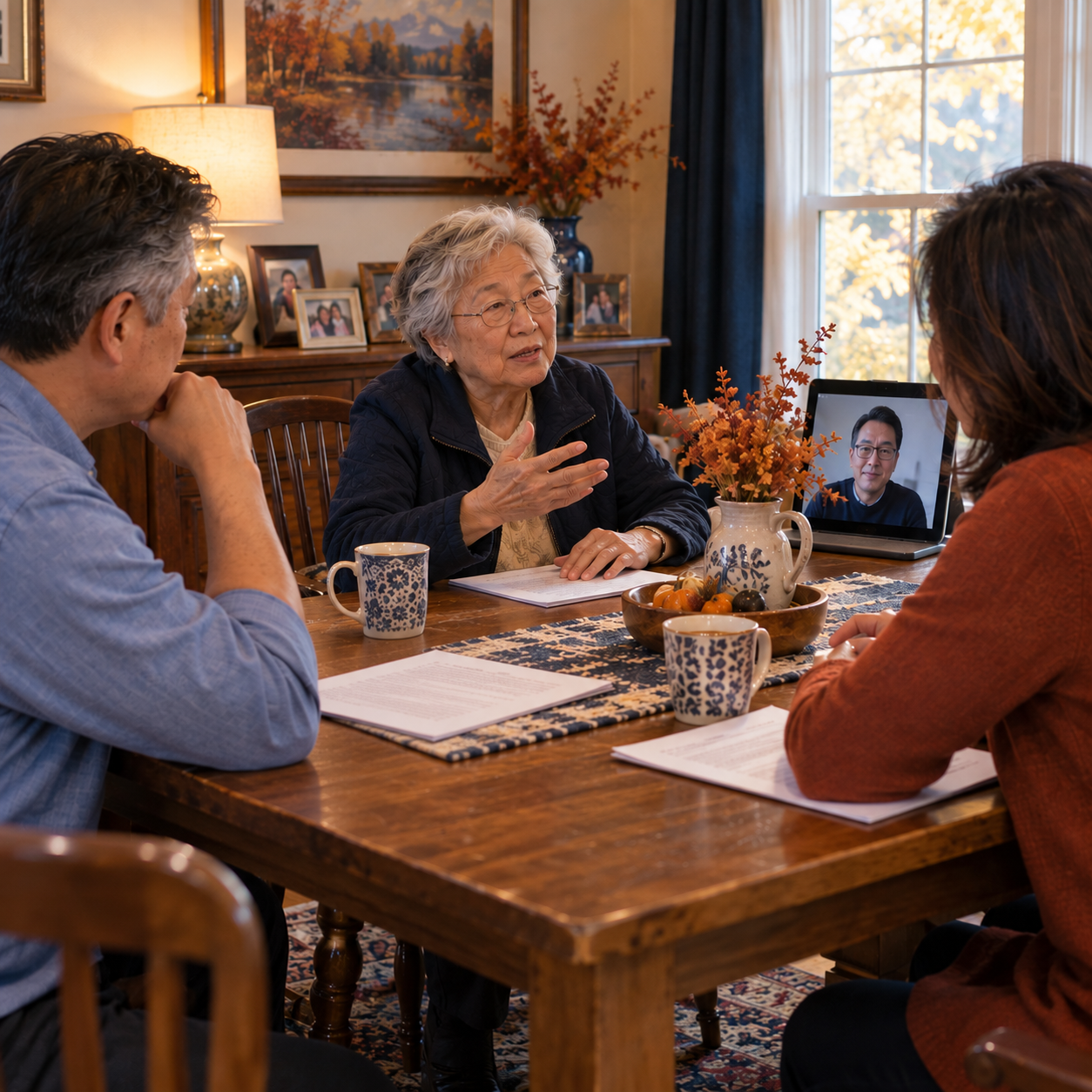
Sort out disagreements between yourselves first. Arriving at your parent’s house as a united group is very different from arguing in front of them.
Keep it short, and agree on what you’ll raise and who’ll raise it.
Divide by strength, not by guilt
Someone in your family is good with numbers. Another is calm at appointments. A third is simply the best on the phone.
Match the job to the person and write it down. Unwritten arrangements quietly revert to whoever lives closest.
Check the supports you’re entitled to
If a parent becomes critically ill, EI caregiving benefits can provide income while a family member takes time off work. The weeks can be shared between eligible caregivers, either at once or one after another.
That last detail matters. It’s designed for families to take turns, which is exactly what most families need.
How Professional Support Helps
Sometimes the fairest division of labour includes hiring someone.
Professional care gives your family one reliable point of contact and one consistent source of information. Everyone gets the same updates, whether they live down the street or across the country.
It also breaks the pattern where one sibling carries everything. Our 24-hour care covers what no family can sustainably manage alone. Nobody stays on call at 3 a.m. indefinitely.
If the pressure started with a hospital stay, our hospital discharge program covers the first weeks home. That’s the period when families burn out fastest and when arguments tend to start.
Hiring help isn’t a failure to care for your own. Often it’s what lets a family go back to being a family.
Bring an Agenda to the Table
Our free October booklet, Around the Table: Noticing Changes and Starting the Care Conversation, includes a printable Family Meeting Agenda.
It’s a simple 45-minute structure. There’s time for what each person noticed, what your parent wants, and who does what by when. Having an agenda keeps a family meeting from turning into an old argument.
Frequently Asked Questions
Should we include our parent in the family meeting?
Yes, whenever possible. Meeting about someone without them tends to produce plans they refuse. Sort out sibling disagreements separately, then bring them in.
What if one sibling controls everything and won’t share information?
Ask directly for a shared list of medications, doctors, and appointments. If that fails, elder mediation exists for exactly this situation.
Can our family get updates if we live in different cities?
Yes. We provide regular updates to designated family contacts in Ottawa, Mississauga, Markham, Pickering-Ajax, Oshawa-Whitby, and Edmonton. The rest of the family can live anywhere.
If Your Family Is Stuck
You don’t need everyone to agree before you call us. Most families don’t.
We’ll help you work out what’s actually needed, which often makes the family conversation much easier to have.
Call 1-866-372-0603 and let’s sort out the care part.
Every family’s situation is unique, but no one should have to navigate senior care alone. Ideal Caregivers 4U provides personalized, non-medical in-home support that helps seniors remain safe, comfortable, and independent at home while giving families true peace of mind.
Learn how we can help by calling 1-866-372-0603 or clicking the link below: